Smart Sustainability Policy Works, California Is Leading the Way to Reduce Emmssions

California’s commitment to set goals to limit emissions output is paying dividends. The state appears to have hit its first target for cutting greenhouse gases and it reached the goal 4 years early.

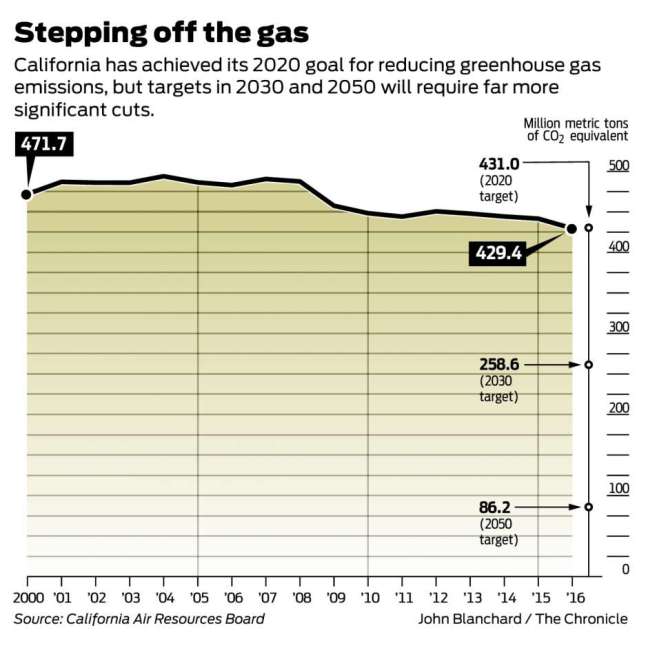
Data released Wednesday by the California Air Resources Board show that the state’s greenhouse gas emissions dropped 2.7 percent in 2016  the latest year available to 429.4 million metric tons. That’s slightly below the 431 million metric tons the state produced in 1990. California law requires that the state’s emissions, which peaked in 2004, return to 1990 levels by 2020. They have a blueprint, goals and a culture to make positive change towards the climate. They have a blueprint, goals, a culture and leadership paving the way utilizing renewable energy to do so.

Cali-Greenhouse-gas-emissions.png

The emissions drop in large part reflects California’s fast rising use of renewable power. (Yessss!!!!)  Solar electricity generation, both from rooftop arrays and large power plants, grew 33 percent in 2016, according to the air board. Imports of hydroelectric power jumped 39 percent as rains returned to the West following years of drought. Use of natural gas for generating electricity, meanwhile, fell 15 percent. What does this all mean? Essentially, California is improving it’s air quality, moving into a new economy of growth and keeping it’s environment in tact for future generations.  This isn’t the end of it, they have goals to reduce emissions 40% by the year 2030.  The complete list of data across different emission sources is found on their website www.arb.ca.gov 
Call us at 480.636.0321 to learn how to lower your carbon footprint, activate your sustainability plan and lower your operating costs with solar electricity.

APS spends $11 million, can’t keep renewable initiative off the ballot

For those who work in the renewable energy industry here in Arizona you’re probably smiling ear to ear when reading this headline. It’s astonishing really because Arizona Public Service (APS) has continually worked to try to diminish the value proposition of roof top solar here in the state. They are not alone as a utility. Salt River Project (SRP) has more or less done the same thing. In 2015 SRP approved rate hikes and demand fees for residential roof top solar. That effectively dropped new solar applications 90% over night. SRP isn’t under the Arizona Corporation Commissions (ACC) regulation. It’s governed by a board of directors that makes independent decisions about how rate plans, billing mechanisms, net metering policies etc. That board of directors is slowly but surely changing as more “renewable energy friendly” board members are being voted in to replace the old crowd.

solar

It’s very possible we can see another change on the horizon. It’s where the voting citizens of Arizona can actually have their “will” fulfilled by holding our public institutions accountable for the health of our environment and community.  That said, it’s we are no way out of the water yet!  APS is fighting this ballot initiative tooth and nail. Earlier today, AZ Central reported that Arizonans for Affordable Electricity, a political action committee whose funding comes from Arizona Public Service Co. parent company Pinnacle West Capital Corp., claim proponents of the clean energy plan did not gather enough valid signatures to qualify for the ballot.  To top it off they are now suing to keep this initiative off the ballot. This means that we, who believe in sustainability and a new economy for tomorrow need to stay vigilant.  We must continue to support the fight for higher levels of sustainability and renewable energy in Arizona.

Call us today at 480.636.0321 to learn how to lower your annual electricity operating costs with solar for your business.

Lockheed Martin’s Gridstar Commercial Solar Energy Storage

The Lockheed Martin Gridstar energy storage system is quickly becoming the “go to” storage solution for large commercial photovoltaic (PV) solar systems.  They have a tremendous amount of flexibility for quick discharge and rapid recharge when properly sized with the correct PV solar systems.

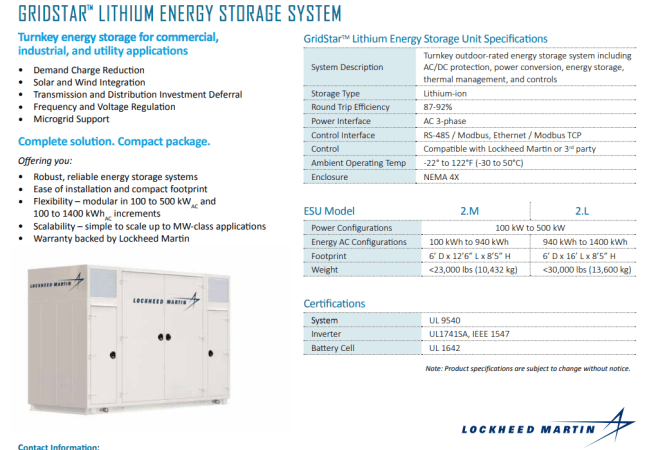
grid star specs

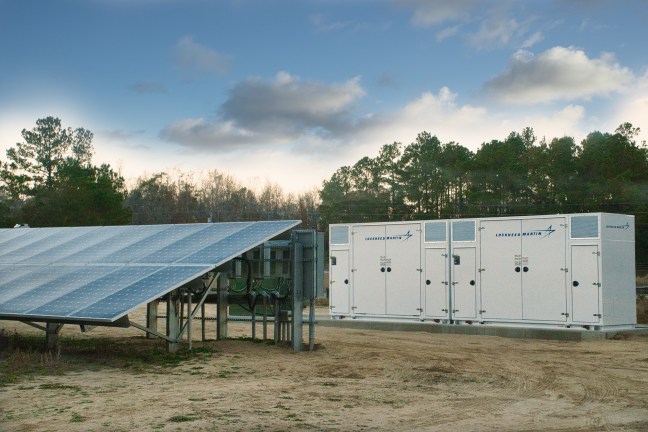
Lockheed Martin’s GridStar Lithium turnkey energy storage systems are compact, easy to install, and scalable from 100 kW to multi-MW projects. GridStar system architecture consists of modular, purpose-built energy storage units that contain batteries, local controls software and all required balance-of-system components. The systems are certified to UL 9540 standards, a key certification for product safety for energy storage systems and equipment. Lockheed Martin is also developing GridStar Flow, featuring the company’s proprietary flow battery technology, for flexible, durable, long-duration energy storage for larger utility-scale projects. Lockheed Martin Energy is a line of business that delivers comprehensive solutions across the energy industry to include demand response solutions, energy efficiency, energy storage, microgrids, nuclear systems and bioenergy generation.

LMEnergy-CypressCreek-Image-Mar18--2

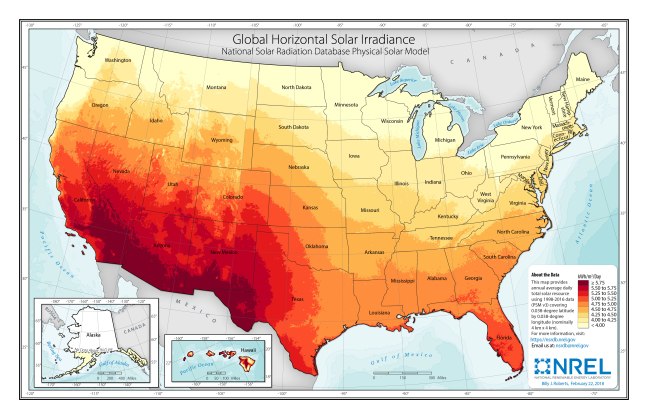
National Renewable Energy Lab (NREL) Solar Irradiance Map : United States

What is solar irradiance and why does it matter? In very simple terms, solar irradiance is the amount of sunlight that strikes an area on the earth. We use it to determine how much electricity a solar panel can produce over the course of a year. Photovoltaic (PV) Solar system designers are able to predict with a 99% accuracy of how much electricity their solar systems will produce for you. The image indicates that the desert southwest are of the US is primarily the best location for solar electricity production in the US. However, even if you do not reside in this area you are still an excellent candidate for solar electricity for your business. States like New York, Massachusetts and New Jersey are quickly adopting renewable energy like solar at a rapid pace. Why? Because these states actively incentivize solar in order to ensure adoption of the technology. Why? Because it’s cheaper and more reliable than traditional sources of fossil fuel sources like coal. States like these are moving towards sustainable energy generation and energy storage to ensure they have energy security, cleaner environments (less pollution) and most importantly economics.

solar_ghi_2018_usa_scale_01

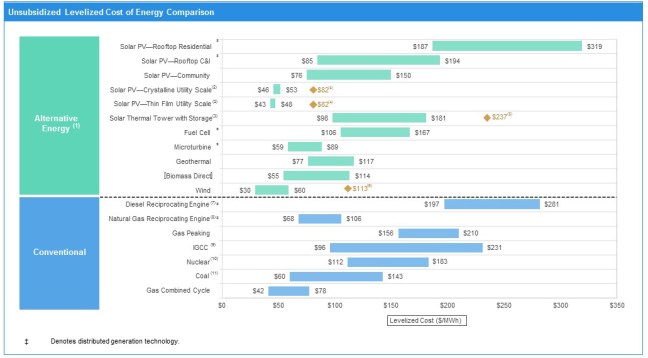
A recent Lazard study argues that one-megawatt solar power now cost half its coal equivalent. Lazard’s latest annual Levelized Cost of Energy Analysis shows a continued decline in the cost of generating electricity from alternative energy technologies, especially utility-scale solar and wind.

chart-1-finally

Solar electricity is a safe, reliable investment that you can use to provide power for your grow operation. There are Federal and State Tax Credits that you are able to take advantage of when going solar. Call today at 480.636.0321 to learn how solar will work to power your business for the next 20 years.

Battery Storage For Commercial Photovoltaic (PV) Solar Systems

In the last few years, commercial battery storage technology has advanced rapidly making solar battery storage a practical option for many organizations.

This video explains how to lower electricity costs using battery storage to reduce utility demand charges. Renewable energy like Sunpower solar panels  and commercial battery storage solution might make sense for your organization.

Demand Charges Explained:

Knowing how your electric use is billed and how your demand and energy charges are calculated will help you understand and manage your total energy costs.

demand

Understanding the energy charge Energy charge is the calculation of the amount of electricity kilowatt-hours (kWh) consumed during the billing period.

Screen Shot 2018-06-26 at 10.43.58 PM

Each of the ten light bulbs above uses 100 watts of electricity. If all ten are lit for one hour, they will have consumed one kWh of electricity: 10 light bulbs x 100 watts x one hour = 1,000 watt-hours (1 kWh) Your meter records the amount of energy used on-peak and off-peak.

Understanding the demand charge


Demand is the rate at which you consume electricity – or the amount needed to power your business at any given point in time. Your demand charges are based on the highest level of electricity supplied at one time during the billing period and at the time of day it’s needed by your business. A single light bulb demands 100 watts of electricity at any given moment. In the energy charge example, the ten light bulbs demanded 1,000 watts (1 kW) of electricity to operate.

Understanding the energy charges on your bill

Your bill will indicate how much energy was used on-peak, we will use the time frame between 9 a.m. and 9 p.m. Monday – Friday, as peak in our example. We’ll use the hours between 9 p.m. and 9 a.m. Monday – Friday, weekends and designated holidays as off-peak. Most all utilities designate weekends and holidays as off peak.

Understanding the demand charges on your bill

You will see demand charges appear as two separate charges on your bill. The first is the On-peak demand charge, this charge is applicable to your peak time frame in addition to your peak rates. You will also see Off-peak demand charges and Off peak rates as well. Most utilities use a 15-minute interval as a period of time to measure your highest level of demand usage. This is when you use the most electric power to run your equipment, lights, etc. During the on-peak time period, in our example, 9 a.m. to 9 p.m. weekdays you get charged an incrementally higher rate. This charge applies only to the rate or volume of electricity your purchase during the peak time frame.

The purpose of your solar electricity and battery system is to discharge your battery during your peak load time frame. This will allow you to eliminate or significantly reduce your demand fees and lower your electricity bill.

Call today at 480-636-0321 to learn how Sunpower solar systems and battery backup can save your business money on your electricity bill.