Arizona renewable energy referendum meets signature requirement

Clean Energy for a Healthy Arizona’s (CEHA) embattled initiative to impose a 50% by 2030 renewable energy mandate has passed another one of the hurdles standing between it and it’s place on the November ballot.

On Wednesday, the office of Arizona Secretary of State Michelle Reagan released the results of the office’s random 5 percent sample of signatures. The review found that over 70% of the signatures reviewed were valid, representing 16,146 of the 22,722 collected. Though the results of Yuma County have not yet been reported, the bill has reached the mathematical requirement to move on.

Furthermore, with the exceptions of Apache, Maricopa and Mohave counties, no county fell below 75% validity, which is funny, considering the utility front group challenging the signatures’ validity, Arizonans for Affordable Electricity (AAE), claimed that same 75% to be the amount of fraudulent signatures.

An important distinction to be made here is that invalid does not mean fraudulent. Invalid signatures could very well just be incomplete or ones that were filled out improperly.

These allegations will still see their day in court, as the two sides will meet before Judge Daniel Kiley on Monday, per AAE’s original lawsuit. With this ballot verification, it would be surprising if CEHA were to lose the case.

The lawsuit should be the final hurdle standing between the renewable energy initiative and the November ballot. Speaking of hurdles, AAE has put so many in front of the initiative previously, that it may qualify for the Olympics, too. The group has previously alleged that CEHA’s signature collection fleet was comprised of violent criminals and at least one Russian spy. AEE has utilized Twitter as an outlet, painting the main backer of CEHA, Tom Steyer, as a “California billionaire” solely hell-bent on raising the taxes of Arizona citizens, with their #StayOutSteyer campaign.

The other pending renewable energy proposal, Commissioner Andy Tobin of the Arizona Corporation Commission’s 80% “clean energy” by 2050 goal, has not received nearly the opposition from AAE that CEHA has. Before going into why, it’s important to remember where AAE gets a significant portion of their funding from.

So why would Arizona Public Service prefer one renewable energy effort over another? Well, for starters, we at pv magazine are not clear that Commissioner Tobin’s proposal is a mandate; as the documentation repeatedly refers to the clean energy targets as “goals”, and does not specify any structure for penalties (such as alternative compliance payments in renewable portfolio standard policies) for not reaching these goals. This could means that unlike the mandatory language of the 50% by 2030 initiative and other renewable portfolio standard policies, utilities would not necessarily any mechanism holding them accountable should they fall behind in their transition to clean energy.

The CEHA initiative also calls for 10% of the total 50% renewable energy to be generated from distributed energy resources. Like other utilities APS has long treated distributed, customer- and third-party owned solar as a threat to its business model and revenues. Commissioner Tobin’s plan also includes nuclear power generation under the blanket of clean energy, while CEHA’s RPS does not. This means under Tobin’s proposal the 3.3 GW Palo Verde nuclear power plant, partially owned by APS and the largest in the nation, would receive incentives based on its output. Under the 50% by 2030 proposal it would not.

The tactics that have been used to fight CEHA’s RPS initiative come as no surprise, since Arizona and the Arizona Corporation Commission are known for having incredibly dirty politics. In this case, there is hope. If the RPS initiative survives its court date, it will head to the ballot, putting the future of Arizona Energy in the hands of the voters. And here it is worth note that the 480,464 signatures the initiative collected represent 7% of the state’s overall population.


This article was originally published on 


After Centuries, Hemp Makes A Comeback At George Washington’s Home

For the first time in what historians say could be centuries, hemp has been grown and harvested at Mount Vernon, George Washington’s historic estate.

In the 1760s, Washington predicted that hemp could be a more profitable crop than tobacco and grew it across his farm. At the time, hemp was abundant in Virginia and elsewhere in the U.S.

This summer, horticulturalists at Mount Vernon partnered with the University of Virginia and planted hemp once again. “To bring this crop back it just really helps complete our agricultural story,” says Dean Norton, the director of horticulture at the estate.

The push to bring back hemp came from a Charlottesville, Va., farmer, Brian Walden, who considers himself a “hemp patriot.”

Dean Norton, the director of horticulture at Mount Vernon, stands in front of the plot of hemp grown this year.

Claire Harbage/NPR


He hoped planting the crop at Washington’s home again could give hemp a public image makeover.

“And [get] the message across that this is an innocuous plant that has real benefits and our Founding Fathers knew that and they planted it.”

But convincing the deciders at Mount Vernon wasn’t easy. “It’s been two generations that we last grew hemp. That means it’s lost from the general population’s knowledge or memory,” Walden says. It took months for him to make the case.

Hemp is still considered a controlled substance by the federal government, but Mount Vernon is able to grow industrial hemp because of a provision included in the federal Farm Bill passed in 2014. It allows states to harvest the crop in limited supply for research purposes only. According to the National Conference of State Legislatures, 38 states considered industrial hemp legislation in 2018.

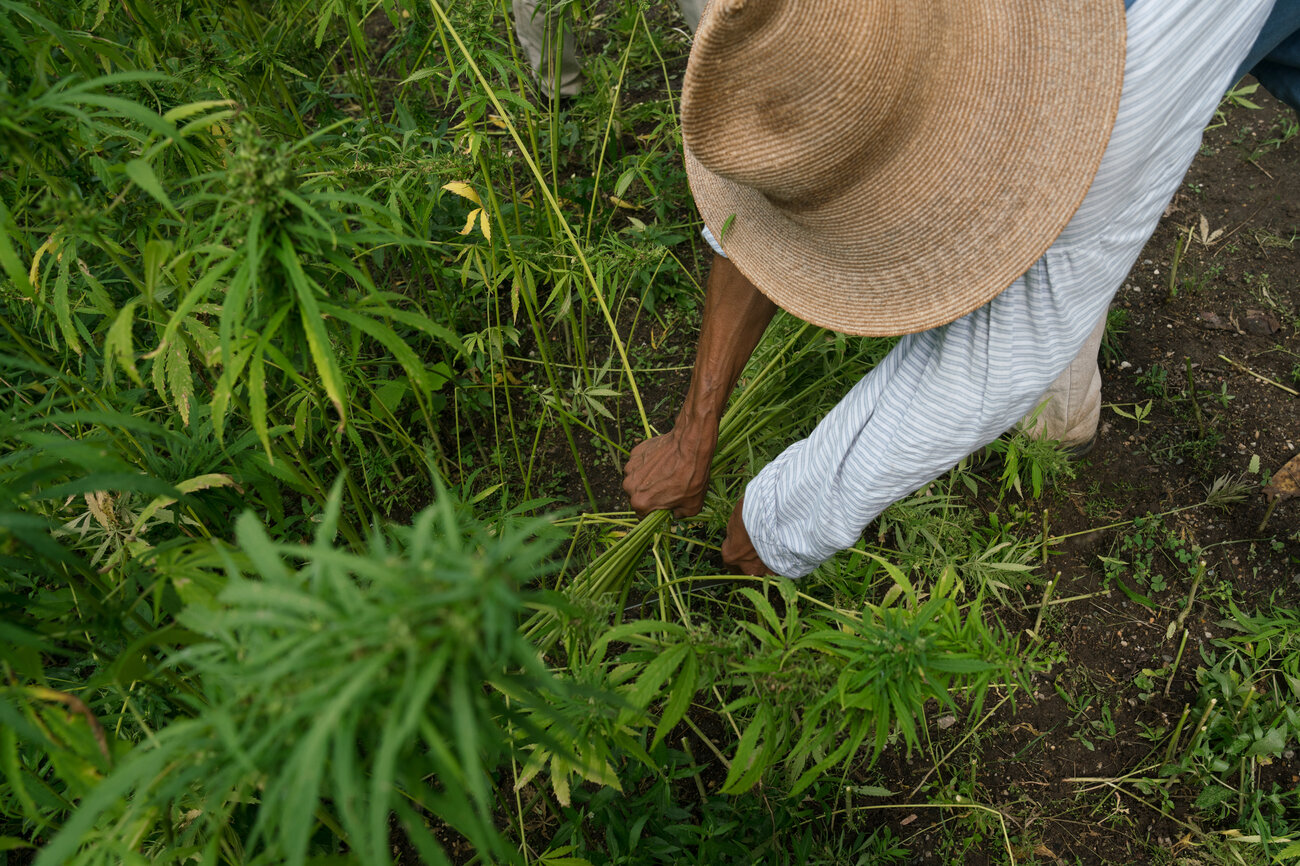
To be clear, the hemp harvested at Mount Vernon is not the type of cannabis you smoke like its cousin — marijuana. Rather, it’s used to make rope, cloth and a host of other products.

Deborah Colburn, a historic trade interpreter at Mount Vernon, demonstrates the process of turning dried hemp into a pliable fiber for making cloth.
Claire Harbage/NPR

Hemp historians say the plant was not just a widely grown crop in Colonial America, but that farmers were mandated to grow it by the British crown because of its versatility and the exceptionally strong fibers could be used for making sails, repairing fishing nets and clothing slaves.

A crackdown on the plant began in the 1930s, when the federal government took steps to tighten control on cannabis, through a Marihuana Tax Act. In 1970 all cannabis plants were lumped together, regardless of THC levels. And ever since, hemp has been a Schedule I drug, just like heroin, LSD and ecstasy.

Hemp historians say that the exceptionally strong fibers could be used for making sails, repairing fishing nets and clothing slaves.
Claire Harbage/NPR

Hemp and marijuana do have similar aromas, but the level of tetrahydrocannabinol – or THC – the chemical that induces the intoxicating high, is minuscule in hemp.

That does not keep Dean Norton, the horticulturalist, from lighting up with excitement when talking about the plant. He gets a kick out of the tourists who stop and take pictures next the seven-foot-tall stalks.

“This is totally for interpretive value,” Norton says. “We could light a bonfire, sit around and nothing is going to happen to you.”

Congress could soon legalize hemp

The Farm Bill is up for renewal this year, and there is chance industrial hemp could become a legal crop. This could be a boon to farmers, like Brian Walden, who predict American hemp production could be a billion-dollar industry.

Brian Walden hoped by having hemp planted at Washington’s historic home, the crop could get a very public image makeover.
Claire Harbage/NPR

According to a June report by the Congressional Research Service, “the global market for hemp consists of more than 25,000 products in nine submarkets.” Hemp fibers can be made into yarns, paper, construction materials even parts for automobiles. Hemp oil can be used in lotions and cosmetics.

Walden says that because industrial hemp is not something a lot of American farmers grow, it is also not a commodity caught in escalating trade war, like soybeans and beef.

Mount Vernon is able to grow industrial hemp because of provision included in the federal Farm Bill passed in 2014. It allows states to harvest the crop in limited supply for research purposes only.
Claire Harbage/NPR

“It is something can boost their farming in a time when tariffs are inhibiting that,” says Walden who is also a member of the Virginia Industrial Hemp Coalition.

John Hudak is a senior fellow at the Washington D.C.-based Brookings Institution and author of Marijuana: A Short History. He says there is a real opportunity to legalize industrial hemp because politicians are changing attitudes towards the plant.

“I think where we’re at right now, is a situation in which, finally a lot of members of Congress … have finally stopped buying drug war-era rhetoric, stopped thinking about the cannabis plant in a very uniform way,” Hudak says.

That includes Senate Majority Leader Mitch McConnell, R-Ky., who has been pushing for industrial hemp’s legalization since April.

“I don’t think it’s a slam dunk, but I do think there’s a real opportunity for passage,” says Hudak.

The Farm Bill is up for renewal this year, and there is chance industrial hemp could become a legal crop.
Claire Harbage/NPR


This article was originally published August 23, 2018 by Brakkton Booker of National Public Radio (NPR) 


Coal Country: EPA Plan Is Short Term Boost, No Solution For Industry Decline

The Dry Fork Station coal-fired power plant in Gillette, Wyo., supplies electricity across the West.

When a business invests in a outdated or inefficient product it loses money. If it doesn’t change it’s business practices it will go bankrupt or shut down. Why? Because something better and more cost effective has come along to replace it. More often than not, changes in markets are due to lower cost options. Coal is a necessity now because it provides “base load power” on a consistent, predictable basis. The replacement to coal is battery storage powered by renewable resources like the sun, wind or ocean tides.  This current change by the Trump administration to lower clean energy requirements on utilities is fruitless and bad leadership. It’s clear that this administration doesn’t make decisions based on the reality of economics and sound business practices.  If they did, they would carry momentum of leaders before them by creating incentives to invest in clean energy in places that are high coal producers. That would create long term jobs, improved grid infrastructure and energy competitiveness on the international scale. Other countries like China are becoming industry titans in the global marketplace in renewable energy.


The remainder of this article was originally published on  August 27, 20184:57 AM ET on the Heard on Morning Edition by COOPER MCKIMFROMWyoming Public Radio

The Trump’s administration’s proposal to relax regulations on carbon emissions is welcome news in coal producing states like Wyoming, even as people in the industry acknowledge its impact would be limited.

“Coal fired power plants are a necessity to keep the… electricity grid stable in America,” says Tom Stalcup, plant manager at the Dry Fork Station coal-fired power plant in Gillette. Large open-pit mines dot the plant’s perimeter, and the light-blue building rumbles as electricity flows to states across the West.

Like many here — where the coal industry produces nearly a quarter of the state’s income — Stalcup worried the Obama-era Clean Power Plan would have forced plants to close. It set targets for states to reduce carbon emissions, and aimed to remake the power grid with a large-scale shift away from coal to renewable power like wind and solar. Two dozen states, including Wyoming, challenged the Clean Power Plan as exceeding the Environmental Protection Agency’s authority, and a court held up the rule before it could take effect.

The Trump administration’s new proposal, called the Affordable Clean Energy rule, would give states more power to regulate carbon emissions. It doesn’t set any cap for emissions, but simply suggests ways that individual plants could become more efficient. In Wyoming, that’s providing new hope that some coal plants might stay open longer.

“It’ll keep some of the plants on,” manager Stalcup says. “I don’t know as if it will keep all of them on.”

One technical tweak that could make a difference is a change in what’s called New Source Review. It was meant to make sure that as coal plants expand or retrofit, they also install the latest, most effective pollution controls. But that can cost hundreds of millions of dollars.

The Trump administration wants to relax this, allowing plants to make minor emissions control changes without having to do a full, bank-breaking environmental upgrade.

“It maybe creates a little bit more of an incentive to invest in some coal-fired power plants, to keep them open a little longer than they might have been otherwise,” says Rob Godby, of the University of Wyoming Center for Energy Economics and Public Policy.

Environmental groups point out this would be bad for public health, as it would increase air pollution from coal plants. In fact, those plants most likely to benefit from the change are some of the country’s oldest, and dirtiest. The E.P.A.’s own projection finds that its new proposal would mean up to 1,400 more premature deaths every year, 48,000 new cases of “exacerbated asthma,” and at least 21,000 more missed days of school.

The economic reality of coal’s decline

But energy analyst Godby says it would only make sense to extend the life of “a very small number” of plants, because coal’s real problem is economic.

“Coal fired power plants have to compete directly with [cheaper] natural gas plants and renewables, where they’re already losing,” he says. “This plan really isn’t going to affect that.”

Over the past decade, coal’s share of the country’s energy mix has dropped from just over half to about a third. According to S & P Global Market Intelligence, utilities plan to close about three dozen more coal units by 2020, and many say they don’t expect that to change despite the new proposal.

Cloud Peak Energy, the country’s third largest coal producer, welcomes the regulatory rollback. But Rick Curtsinger, director of public affairs, says more could still be done to protect the coal industry. He says the company would even like to see Congress step in, with legislation “that gives long-term certainty to utilities to make the 20 and 30 year investments necessary.”

It’s not clear what, exactly, that would mean. But the Trump administration has repeatedly raised the idea of subsidizing struggling coal and nuclear plants.

The administration’s Affordable Clean Energy proposal is open for public comment. If it takes effect, environmental groups and some states are threatening a legal challenge.

Gillette Mayor Louise Carter-King says the plan would really be just a short-term boost. What’s more, she says, regulation of carbon emissions could be stepped up again after the next presidential election.

“It’s that uncertainty that’s tough on people and the industry,” she says.

Utilities are also mindful of that uncertainty, another reason President Trump’s latest lifeline to the coal industry may not change much.


Arizona Utility APS’s Real Plan: Fossil Fuels Forever

Arizona’s biggest investor-owned electric utility, Arizona Public Service (APS), wants to lock the state into a fossil-fuel-based future, even though there is a clean, reliable energy option that would lower electric bills, reduce health-harming emissions, and create thousands of jobs. APS is vociferously opposing the Clean Energy for a Healthy Arizona ballot measure, which would require utilities to get 50 percent of their electricity from renewable sources like solar and wind by 2030. The likely reason: APS wants to build a bunch of new gas-fired power plants, and they will make less money in a world where the ballot measure passes and their dirty-energy-building-boom no longer makes sense.

We know APS’s plans because they filed a detailed proposal — called an Integrated Resource Plan (IRP) — at the Arizona Corporation Commission last year. In the IRP process, Arizona utilities map out how they will meet customers’ electricity needs over the next 15 years.

APS proposed no new large-scale solar plants in its plan. This is shocking. The plan covers the next fifteen years, Arizona generates just six percent of its electricity from solar, and solar costs so little in Arizona. Instead of building renewables, the utility proposed a massive, multi-billion-dollar build-out of fossil fuel-fired power plants: 2,000 Megawatts of gas combined cycle units (which are designed to operate around-the-clock), and 3,500 Megawatts of gas combustion turbine units (which are designed to meet peak needs). This building boom would increase gas-fired power plant capacity substantially, from 57 percent of total capacity today to 66 percent in 2032, and substantially increase APS’s use of fossil fuels. Use of coal and gas for energy production would increase by 40 percent between 2017 and 2032.

APS wants to meet Arizona’s future electricity needs almost exclusively with fossil fuels
In the plan, gas-fired resources account for 99.7 percent of APS’s new electricity generation, and large-scale solar is absent. The utility does not plan to build any new utility-scale renewable energy power plants (there’s just one, small wind contract extension). APS’s plan also cuts energy efficiency programs in half, and they propose just a small amount of energy storage.

In contrast to APS’s “fossil fuels forever” plan, a 50 percent renewable energy future can meet Arizona’s electricity needs at lower cost and risk than APS’s plan, with big environmental benefits. Modelling of a renewable energy future conducted by the research firm ICF for NRDC finds that 50 percent of the state’s electricity needs can be reliably met by renewable energy by 2030. A 50 percent renewable portfolio standard would lead to the development of 5,320 Megawatts of solar capacity by 2030.

Building those new solar power plants would create jobs, and take away the need for any new gas plants and the out-of-state fuel they require. Our modeling — described here — suggests the renewable energy future would reduce energy infrastructure costs by $4.1 billion between 2020 and 2040 and reduce energy bills, because new renewables are cheaper than unneeded gas plants.

APS spends a lot of time talking about the Palo Verde Nuclear Generating Station. But they are just trying to confuse people. Their real plan is all fossil fuels, all the time. A renewable energy future would be better for Arizona’s economy and environment.

Originally posted on the Natural Resources Defense Council website. 

Marijuana Growers Now Qualify For Energy Discounts In California

Agricultural Cannabis Growers Now Eligible for PG&E Ag Rate and Programs

Release Date: March 01, 2017
Contact: PG&E External Communications (415) 973-5930

SAN FRANCISCO, Calif. — While recreational marijuana cannot be sold in California until January 2018, existing medical marijuana growers and future recreational marijuana growers will be eligible as of March 1 for PG&E’s agricultural energy rate.

The passage of Proposition 64 in November 2016 allows the state to license and regulate recreational marijuana cultivation and businesses.

“Cannabis is a legal crop in our state, like almonds and tomatoes. Agricultural growers now will be eligible for the same rate and energy efficiency programs as farmers of other crops,” said Deborah Affonsa, vice president of Customer Service at PG&E.

PG&E customers are eligible for agricultural energy rates if they have received a permit from their local jurisdiction for the cultivation of cannabis and if 70 percent or more of the annual energy use on the meter is for agricultural end-uses such as growing crops, pumping water for agricultural irrigation or other uses that involve agricultural production for sale which do not change the form of the product. The agricultural energy rate applies to both customers who grow cannabis outdoors and those who grow indoors in commercial greenhouses.

The agricultural energy rate does not apply to residential customers who can legally grow up to six marijuana plants inside a private residence per the state Adult Use of Marijuana Act.

Previously, medical marijuana was not considered an agricultural product by PG&E, and growers were not eligible for the agricultural energy rate. Because medical marijuana can be grown and sold in California currently, licensed growers of medical marijuana are immediately eligible for the agriculture energy rate.

Cannabis growing operations can use an extremely large amount of electricity and are considered to be equivalent to other energy-intensive operations such as data centers.

“We’ve met with representatives of the emerging legal cannabis industry and listened to their needs. We are here to help our customers make smart, efficient and affordable energy choices. Now that cannabis is in California’s future, our next step is to work with these new agricultural customers and make this industry as energy efficient as possible,” said Affonsa.

PG&E’s agricultural rates are under the jurisdiction of the California Public Utilities Commission and the state of California.

Agricultural customers with questions about rates, rules and energy efficiency programs can learn more at pge.com/ag or contact PG&E’s dedicated Agricultural Customer Service Center at 1-877-311-3276.