Blog

A Greener Green Part 1: Energy Consumption

States and businesses across the industry are taking the initiative to produce more sustainable and energy-efficient cannabis to reduce their environmental footprint.

As the cannabis industry continues to grow, national attention is often negatively directed towards the industry’s environmental footprint.  Unfortunately, this is not without cause.  Because policies most often force cultivation indoors, cultivators are forced to simulate highly energy-intensive ecological conditions.  Lighting, ventilation, dehumidifiers, air conditioning, CO2, drying, and transportation are just a few factors of cultivating cannabis that requires expending energy.  Today, cannabis is the most energy-intensive agricultural commodity and remains to be one of the most energy-intensive businesses per square foot.


The Problem

The energy demands of indoor cannabis cultivation are the most significant contributor to the industry’s environmental footprint.  Although policies continue to force grows indoors, there are no industry-wide mandates to impose energy-efficient standards.  It is common for cultivators to use high-pressure sodium (HPS) lights to imitate desired growing conditions, whose illumination is on par with those found in an operating room, and 500 times higher than that recommended for reading.  Although some cultivators use the more energy-efficient LED lights, their overall environmental benefit within the cannabis industry has yet to be determined.  When using LEDs, while consuming less energy, grow cycles tend to be longer and may average out or raise overall energy expenses.

study published in 2012 estimated that energy consumption by the cannabis industry accounts for 1% of the national electricity use or 6 billion dollars worth of energy – and that was in 2012.  The study also reported that national-average annual energy costs are approximately $2500 per kilogram of finished product, and one kilogram of processed cannabis results in 4600 kilograms of CO2   emissions; which is the equivalent of driving across country 11 times in a 44-mpg vehicle.

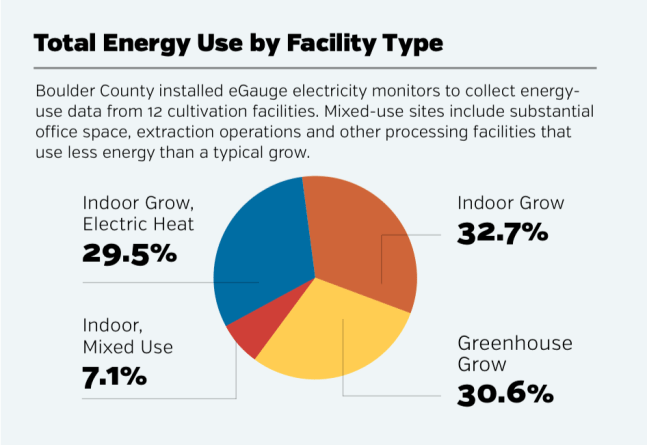
Current statistics are just as alarming.  In Boulder County, the average electricity consumption of a 5,000sqft indoor cannabis facility is 41,808 kilowatt- hours per month.  For comparison, the average household uses 630 kilowatt-hours per month.   From 2015 to 2016, cannabis cultivation and processing areas increased from 114,197sqft to 170, 341sqft, thus causing a 71% increase in energy expenditure.

Due to the federal government’s opposing stance on cannabis, producers are not able to reap the benefits that other industries do when implementing energy-efficient practices.  Cultivators and producers receive no tax breaks, nor do they have the ability to become USDA organic.


The Solution(S)

The factors as mentioned above, in addition to the current overall lack of governmental support, have led to the development of state-based certifications and incentive programs.

In Oregon, Eco Firma Farms has made outstanding improvements to their grow, allowing them to exponentially reduce their environmental footprint and bottom line.  Working in tandem with Energy Trust of Oregon, Eco Firma Farms has made multiple improvements that have led to a quick and qualitative ROI in addition to reducing their environmental footprint.  These energy-efficient improvements returned an estimated annual savings of $63,000, and incentives received for updating their operation totaled $99,800.  Eco Firma Farms currently operates on 100% wind-powered renewable energy and practice only organic pest, mold and mildew procedures.  Last year, they were awarded Portland’s General Electric (PGE) Green Mountain Energy Gold Certification, and are on track to receive Platinum Certification in 2018.

Programs and efforts to produce more environmentally friendly cannabis are starting to develop throughout the industry.  Denver currently has the goal to shrink their greenhouse gas emissions 80% by 2050 through boosting the use of renewable energy.  In California, MITU Resources, Inc. is planning the commercial introduction of the company’s licensed Wind Shark, a self-starting vertical-axis wind turbine.  The integration of the Wind Shark into the CA cannabis sector, it is hoped, will reduce a cultivator’s daily energy expenditure by 10% and their bottom line.

As is the repeated case in the cannabis industry, it continues to grow at such an exponential rate, that supporting industries have difficulty keeping up with it.  Energy-efficient practices and standards are no exception to the rule, which also includes data collection, cultivation techniques and technological developments to name a few.  States have and continue to, create energy programs to reduce the environmental footprint created by the cannabis industry.  Independent certifications and product labeling ensure that companies are making their achievements and impact visible to consumers, thus spreading positive program awareness.  Undoubtedly, the cannabis industry will continue to grow before industry-wide energy standards are implemented, however, states, cultivators, and processors are becoming more proactive in these matters.  Steps taken now throughout the industry will have a significant impact on reducing the industry’s environmental footprint, as well as further validate the industry.

This article was originally published on www.cannabistech.com by 

OLEDs Moving From Television Screens To Cannabis Grow Ops

Low heat and energy efficient lighting could dramatically change how we farm cannabis.

The arguments for switching to LED (light emitting diodes) are by now well established. Still a significant upfront investment, LEDs provide a complex spectrum of light, using substantially much less energy and emitting much less heat than conventional HPS lighting used in indoor cannabis farms.

The marijuana sector has certainly made a move towards an LED focused approach to lighting over the last decade. But is that about to change with OLEDs? Futurists have started to discuss the new possibilities posed by OLEDs, or Organic Light Emitting Diodes, in indoor agriculture, and it seems an increasingly likely move.

Despite OLEDs infiltration into our LG and Apple screens, cannabis farmers remain in the dark about the technology. OLEDs have been around for nearly 30 years, but only recently has it grabbed headlines. This is mostly thanks to their adoption by the high-end television sector. OLEDs are the reason why new 80-inch television screens are under a quarter inch thick, and flexible. So why does an OLED television technology make sense in the cannabis world?


Improving On LEDs, The Unique Characteristics Of OLEDs

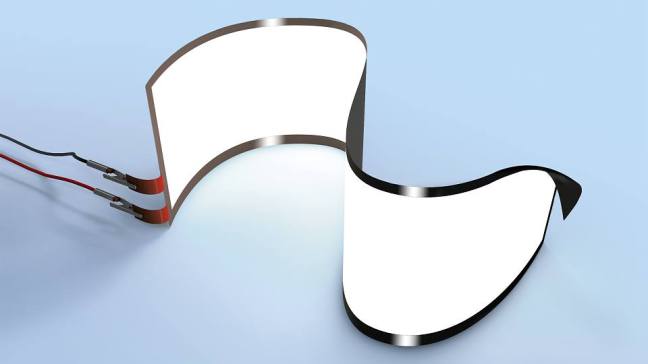
441x200_bend_OLED_copy_2Newer iterations of OLED technology now use graphene as the organic material, which is cheaper and easier to produce than previous designs. Yet, graphene is still challenging and expensive to mass produce. Screens using OLEDs, which arguably produce the best image in the industry, are almost always the most costly option for consumers and producers alike.An OLED is a stable structure made up of extremely thin layers of organic material, now mostly designed out of a compound called graphene. The screen is exceptionally flexible, can be ink-jet printed and just like LEDs it produces light when an electric current passes through its structure.
If OLED technology is still in its infancy, why are some cannabis industry analysis theorizing about OLEDs replacing LEDs? OLED technology has in many ways taken all the best components of LEDs, and improved upon them. For example, OLEDs require much less space to install yet produce the same intense light as an LED.

An OLED lighting system would require under an inch of space, thereby allowing cannabis cultivators to pack more into small grow rooms. They also produce little to no heat, which could eliminate the need for the bulky and costly HVAC systems used throughout the sector today. The energy savings, even when compared to an LED, are also substantial.

But the cost savings and reduced space requirements of OLEDs aren’t the game changer. The fascinating characteristic of OLEDs is the way they can be manipulated into innovative designs; printed on a flexible substrate and manipulated to suit the growing environment. They are thin enough to be translucent, theoretically making it easy also to take advantage of natural lighting.


The Future Of OLED Lighting In Cannabis

It’s true that OLEDs have a long way to go before they completely replace LED grow lights in cannabis and for other indoor crops. But that isn’t to say the technology isn’t already making leaps and bounds towards a future in agriculture. Students at the Brunel University London have already started incorporating OLED technology into vertical farming designs.

Considering many indoor cannabis operations take advantage of vertical farming to conserve space, it will be interesting to see how OLEDs roll out in other vertically farmed crops.

Many expect OLEDs to drop in price, as manufacturing techniques improve, mimicking the course of LED lighting. Already, research centers and tech companies are working on cheaper, easier ways to manufacture graphene, which is still one of the main reasons why OLEDs are so challenging to produce.

In recent months a team at Kansas State University may have accidentally stumbled on a cheap graphene production method using a spark plug of all things. Titan Hemp has also developed an all natural hemp-based plant fiber, which they propose is superior to graphene. Currently, they’ve marketed it for superconductor batteries, but there may be future applications in OLED technology. The irony is not lost that a future of a hemp-based OLED for growing cannabis is within sight.

While OLED lighting technology is still likely a few years away in cannabis, even for early adaptors, its potential to change the industry is huge. Once again, a new method of low heat, energy efficient lighting could dramatically change how we farm cannabis. The cannabis industry is experiencing fast paced innovation in facility design and crop science, unlike anything ever seen before. Its likely OLEDs could experience a much faster adoption rate.

This article was originally published in https://www.cannabistech.com/ by Jessica McKeil

Electric Utilities Work With Cannabis Growers to Save on Power Costs

Understanding how your utility is charging you for electricity and how to maximize your electricity consumption in order to maximize your yield is essential for your business.

Despite knowing for years that electricity is a major expense that can significantly affect everyone’s bottom line, marijuana businesses – especially growers – are still struggling to keep costs manageable.

The good news is that a burgeoning number of utility companies are working with cannabis cultivators to better manage costs by:

  • Conducting in-depth case studies to better understand energy-consumption issues.
  • Assigning employees to work exclusively with marijuana businesses.
  • Recommending lighting as well as heating, ventilation and air-conditioning (HVAC) systems, which they say can save cultivators tens of thousands of dollars annually.

Here are some of the points growers are focusing on as they consider potential energy savings:

1. Keep an open mind

Electricity consumption typically is the second-largest cost incurred by indoor cultivation facilities.

That said, marijuana business executives can benefit from working with utility operators – provided an MJ exec is willing to as well.

“In May of 2017, I started devoting 100% of my time to the cannabis operations coming into our territory, knowing that all those companies were going to fill one portfolio of commercial account management,” said Matt McGregor, strategic account manager, cannabis operations, for the Sacramento Municipal Utility District (SMUD).

McGregor estimates he has roughly 200 marijuana customers, mostly growers, but also about two dozen customers involved in extraction, infusion, processing and packaging.

While more cultivators are accepting or seeking help from utilities, many remain leery.

“Some growers are extremely open and want us to learn,” McGregor said, “and some, we have just one conversation with and then we never see them again.”

2. Understand the public/private difference

Not all energy companies are willing to help. Their cooperation depends in large part on whether they are dependent on one of the nation’s four federal power administrations which serve most of the United States, or one of the nation’s federally owned companies such as the Tennessee Valley Authority.

Utilities that receive their power from these federal entities generally balk at providing cannabis businesses because they fear federal interference.

Private utilities are less prone to those fears. Consider Puget Sound Energy (PSE), an investor-owned utility in Washington state, which has helped about 80 cannabis customers with about 100 energy-savings projects since 2014.

PSE doesn’t get power or conservation funds from the region’s federal power company, the Bonneville Power Administration.

Rather, PSE buys the power it sells to customers off the market or from its own power generation.

“So, we didn’t have to be concerned about losing federal funding by serving the cannabis sector,” said David Montgomery, an energy management engineer with PSE.

He added that cannabis businesses are “legal within the state and the state is our governing body, so we’re going to treat them like any other customer.”

Xcel Energy – a private utility operator serving eight Western and Midwestern states including Colorado – goes by the same premise.

“We work with marijuana companies because they are legal operating entities in the state of Colorado,” Xcel spokesman Mark Stutz said.

“We are regulated at the state level, and to deny services would be in violation of state law.”

3. Consider the mutual benefit for both growers and utilities

It’s also in the interest of utilities to help growers cut their costs.

As more customers demand more energy, utility companies may have to build new power plants to supply customers’ demands, which is costly.

It’s cheaper to persuade existing customers to reduce energy usage by using conservation practices and buying newer, more efficient lighting and HVAC.

“It was difficult in the first several years of legalization from an operational distribution standpoint to meet the needs of some of the growers,” Xcel’s Stutz observed.

The utility had historically set up electric distribution systems in warehouse areas that were meant to meet certain loads.

Later, these districts became home to cannabis cultivators, and the energy consumption increased dramatically, he explained.

“This meant that we often had to upgrade distribution to meet the higher, 24-hour demand for use,” Stutz said.

Now, utilities are looking to the cannabis industry as a place where they can help customers take pressure off the grid.

“With the legalization of the cannabis market in Massachusetts, and the fact that this business is extremely energy-intensive, this is an agricultural area where there is opportunity to proactively influence the design of these facilities in order to mitigate their very significant energy demand,” noted Robert Kievra, a spokesman for National Grid, a major utility in Massachusetts.

About 70% of the cannabis facilities in National Grid’s service area participate their rebate and incentive programs, Kievra added.

4. Consider LED and HVAC technologies 

Energy companies say the best way for marijuana growers to reduce their energy consumption is to switch from conventional lights to LED, and to upgrade HVAC.

But many growers remain skeptical of LED lights, something that McGregor blames on a lack of education.

“Trying out LED technology from two years ago is like trying out a 10-year-old laptop,” McGregor said.

Because cultivators also have a lot to gain from marijuana-related energy rebates and incentives, lighting companies are often the ones connecting utilities with growers.

“The folks who are really out there pushing LEDs, and saying PSE has money available, are the lighting companies and their reps,” PSE’s Montgomery noted.

“They’ll bring us growers with whom we can do projects with,” added Montgomery, noting that his company works with about six lighting firms that provide customers with LED technology.

“The lighting companies are aware of our incentive programs, so when they’re selling lights they tell the growers, ‘Hey, we can work with PSE. They have cash available to help pay for these lights because they’re more efficient.”

Montgomery estimated he saves his marijuana customers about 50 million kilowatt hours per year.

A kilowatt hour is a unit measuring the amount of watts used over 60 minutes. For example, 1,000 watts of power used for one hour represent one kilowatt hour.

Despite outreach from PSE and lighting companies, cannabis businesses may have not taken much advantage of incentive programs.

For example, Montgomery reckoned that LED lights should be installed at about one light per a 4-foot-by-4-foot area of canopy.

That means 10,000 square feet of canopy would require about 625 lights, with each light costing about $1,000 each.

Montgomery said PSE typically picks up 50%-70% of that cost through rebates, although it’s sometimes lower based on the types of lights that are chosen.

“Even if we can pay a big part of it, they’re still on the hook for their portion of the project costs,” he observed.

This article was originally published in MJ Biz Daily. https://mjbizdaily.com/ written by

Omar Sacirbey  who can be reached at omars@mjbizdaily.com


Lowering Electricity Bills Without Sacrificing Crop Yields

Electricity consumption is typically the second-biggest cost incurred by indoor cultivation facilities (and often greenhouses), behind labor. According to cultivation company data analyzed by the nonprofit Resource Innovation Institute, grow facilities on average expend about 275,000 kilowatt hours per square foot of canopy. Some grows spend much more, while outdoor grows spend little or nothing on electricity, according to Derek Smith, executive director of the Portland, Oregon-based research organization.

Screen Shot 2018-07-31 at 3.28.01 PM

The high cost of electricity for indoor growing shouldn’t come as a shock, so to speak, given a grow facility’s need for lighting, air conditioning, dehumidifying and other demands. “ The more competitive the market gets, the more people are going to have to pay attention to resource management,” said Casey Rivero, head grower at Yerba Buena in Hillsboro, Oregon. “Power is one of your biggest costs, and being able to efficiently maximize your power is key.”

While reducing your cultivation site’s electric bill without making major sacrifices on yield and quality may sound like a tall order, there are ways to do it. The two biggest consumers of electricity, according to a 2014 study performed by the Northwest Power and Conservation Council, are lighting, which accounts for about 38% of energy consumption, and dehumidification and ventilation, at 30%. Cooling takes up 21% of power demands, while the remaining 11% of power use can be attributed to heating, water management, CO2 and curing. That said, the easiest place to seek energy savings is through lighting – in addition to heating, ventilation and air conditioning, or HVAC. Here are three ways to cut your electricity bill.

1) Determine How Much Juice You’re Consuming

To save on power, you first must know how much electricity you’re consuming and what it is being used for, such as lighting and HVAC. The simplest way to measure how much you’re using is to calculate your kilowatts per day.  Next, estimate how many hours per day your lighting and HVAC equipment are running and at what power level to understand how much juice is going to each. Growers should know that the amount of lighting and HVAC being used will depend where plants are in the growth cycle. Outside conditions play a role, too, because air conditioners and dehumidifiers must work harder on hot and/or humid days, respectively.

“It’s kind of a guestimate, but it’s better than nothing,” Rivero said. To get more accurate data, Rivero suggests using power monitors that can be placed on breaker boxes to track electricity consumption based on a particular power source, such as a specific wall of air conditioning units or lighting panels. How many breaker boxes a cultivation facility has varies on the size and design of the facility as well as what kind of power service systems (single phase or three phase) and voltage power the site. Yerba Buena, for example, has individual subpanels for lighting in every room as well as a panel for each of the facility’s 10 HVAC units. There are also panels for less power intensive equipment, like water pumps. Basic power monitors cost between $600 and $1,000, while the most expensive models can hit $10,000, Rivero estimated.

Screen Shot 2018-07-31 at 3.39.19 PM

A cultivation site doesn’t need to buy a power monitor for every breaker. But having several makes it easier to run comparisons, say between different grow rooms, different days or between lighting and HVAC units within a room. In addition, energy-management companies can install data equipment to make it easier to track and manage power consumption.

Screen Shot 2018-07-31 at 3.39.29 PM

2 ) Get the Lowdown on LEDs

While lighting uses the most electricity at indoor grow sites, most cultivators still use high-pressure sodium lights, typically 1,000 watts. Not only is the wattage a major energy drain, but HPS lights produce high heat, forcing air conditioners and dehumidifiers to work harder adding to utility bills. More efficient and environmentally friendly LED lights have been around for several years, but only a small number of growers have adopted them. Many growers acknowledge that LED lights are more efficient but argue that they don’t produce the yields that HPS lights do and, therefore, reject them. For example, Massachusetts marijuana industry executives were up in arms in March after regulators imposed a cap on electricity use amounting to 36 watts per square foot of cultivation space. The move, in effect, forced growers to adopt LED lights a move some executives hope to overturn.

When Allison Justice arrived at San Diego County, California-based OutCo in late 2016, she also was told that LED lights couldn’t perform like HPS lights, and that whatever the cost savings, they would be lost to the lower yields that were expected. Justice, OutCo’s director of cultivation, wanted to see for herself, so last year she started running trials comparing 1,000- watt HPS lights with LED lights from Fluence, a commercial LED firm whose wattages were 330, 560, 660 and 1,000. More wattage equals more light intensity. Testing on two strains, Justice and her colleagues found the LED 1,000-watt lights produced 21% higher yield than 1,000-watt HPS lights, while 660-watt LEDs resulted in 13% more yield and a 37% drop in energy use. At 37% decrease, Justice noted, didn’t account for savings from the air conditioners, which ran less because LEDs give off less heat. Justice acknowledges that LEDs are more expensive – a Fluence 660 is about $1,280, while a standard HPS light is around $400 but the cost is more than outweighed by the energy savings and increased yield.

Another advantage of LED’s: They allow growers to “double stack” a layer of plants on top of another one, effectively doubling the cultivation space. How? Because HPS lights are so hot, they must be farther from the plants than LED lights, which are cooler. “It’s like getting another facility for free. The ROI on that is a no-brainer,” Justice said, referring to return on investment.

Following the successful tests, OutCo started retrofitting its facility for LED lights late last year, essentially interrupting production for six weeks to tear out old benches and lights and install new rolling benches, irrigation, drainage, HVAC and other equipment. Since then, Justice and her team have harvested two crops each of several strains, including Mendo Breath, Cookie Pucker, Grape Pie, Strawberry Banana and Black Jack. “Yield and quality is phenomenal,” Justice said. “ There’s always tweaking to do when you start something like this. Overall we’re very happy.” Other cultivators are also gaining confidence in LEDs. “I was a holdout because I never saw the production that I could get out of an HID (high-intensity discharge) with an LED. They are now rapidly catching up,” said Eli McLean, a cultivation consultant and commercial grower in Salem, Oregon. “Once you run the numbers, you realize that you get good yield of top-shelf cannabis that cost me a third less to produce.”

McLean is now researching LED lights with quantum dot technology that he said operate at about 91-92 degrees Fahrenheit. The lights are manufactured by a company called QD Grow. “ is means you’ll need far less latent cooling because you have far less latent heat,” McLean said. “I think you can see savings on your cooling costs of up to 65% for LED versus what’s being used today.”

3) Make Your HVAC Less Power Hungry

Finding ways to reduce HVAC power use is good for the environment and your company’s finances. Yerba Buena was able to get rid of its dehumidifiers, for example, which significantly reduced the company’s utility bills. How did the Oregon grower do it? It adapted sensors that measure leaf moisture and air humidity and wired them to activate air conditioners (which also perform dehumidification) when the leaf surfaces reach a certain moisture level. Remember that leaf surfaces can transpire moisture because of heat from grow lights. By activating air conditioners when leaves start to transpire – versus waiting for a preset interval Rivero can both absorb air humidity and lower temperatures that had risen because of light heat. That, in turn, reduces leaf transpiration even more.

Screen Shot 2018-07-31 at 3.52.39 PM

By reducing overall plant transpiration, and more efficiently timing air conditioning use, Yerba Buena was able to regulate and reduce humidity, so it could be handled by air conditioning alone. e company ditched its last dehumidifier in February. “Our goal is to stabilize that humidity and heat. You need to pay attention to the leaf surface, because the leaf surface temperature is what’s going to allow that water to come out of the plant,” Rivero said. “ The more sensing and control equipment you have that talks with HVAC and lighting together rather than separately, the easier it is to achieve that balance, as opposed to having those things separate and hope they line up.”

This article was originally published in Marijuana Business Magazine • July 2018

https://mjbizdaily.com

Solar System Incentives & Tax Credits

Both the Federal and State governments pay for a portion of your solar system when you purchase it.  The federal government pays 30% of total gross system cost via a Federal Tax Credit. Depending on your state they will also pay a portion of the system cost in state tax credits. In Arizona for example, the state will pay an incentive of 10% up to $25,000 for any one building. A single business can apply for this incentive twice per year to cover multiple buildings up to $50,000, or $25,000 per building. Depending on the utility there may be rebates which pay for a portion of the renewable energy or battery system.

federal-solar-tax-credit-2017_canna_solar

The Investment Tax Credit (ITC) is currently a 30 percent federal tax credit claimed against the tax liability of residential, commercial and utility investors in solar energy property. The residential ITC allows the business that installs, develops and/or finances the project claims the credit.  A tax credit is a dollar-for-dollar reduction in the income taxes that a person or company claiming the credit would otherwise pay the federal government. The ITC is based on the amount of investment in solar property. Both the residential and commercial ITC are equal to 30 percent of the basis that is invested in eligible property which have commence construction through 2019. The ITC then steps down to 26 percent for projects that begin construction in 2020 and 22 percent for projects that begin in 2021. After 2021, the residential credit will drop to zero while the commercial and utility credit will drop to a permanent 10 percent. Call 480-636-0321 today to learn how much in solar tax credits you can receive with a solar system for your business.