Blog

SolarStratos To the Edge of Space With Sunpower Solar Panels

SunPower isn’t just powering roofs and solar farms these days. The company, which touts its solar panels as the most durable and efficient on the market, is looking at other applications. I’d be hard pressed to find one as awesome as the upcoming Mission SolarStratos expedition which will be powered by its 22-24% efficient Maxeon™ solar cells.

The SolarStratos is an electric plane that has the flight characteristics of a low drag glider. It has extremely long thin wings and a very small profile.  However it is outfitted with an electric motor, a very efficient front propeller, and wings and tail covered with around 24 square meters of solar panels. Inside fit up to 2 pilots in fighter configuration and what appears to be a 20kWh battery (nearly the same size as the 125 mile Hyundai IONIQ).

Interestingly this plane will not be pressurized, requiring the pilots to wear space suits that are also powered by the energy from the solar panels and stored in the battery.

Some stats from the press release (below):

  • Length: 8.5 meters – about 30 feet, or the distance from the end zone to the 10-yard line on an American football field
  • Wingspan: 24.8 meters – about 81 feet, or the length of two standard city buses
  • Weight: 450 kilograms – about as heavy as a grand piano; to make SolarStratos its lightest, the cabin will not be pressurized, requiring pilots to wear astronaut suits that are pressurized by solar energy
  • Engine: 32-kilowatt electrical engine, about one-third the size of what would power an electric vehicle
  • Energy: 22 square meters of SunPower Maxeon solar cells, each reaching 22 to 24 percent efficiency
  • Batteries: One 20-kilowatt lithium ion battery
  • Autonomy: Self-generates electricity with solar to power the plane for more than 12 hours

Contact us today to learn how Sunpower solar panels can power your commercial business by lowering your annual operating costs.  Call 480.636.0321

The 3 Types of Onsite Commercial Solar Installations

Canna Solar offers a variety of solar equipment options for you to choose from when you go solar. One of our most popular equipment product lines is Sunpower, a US solar panel company.

primary_logo

When you decide to move forward with solar for your business, the placement and type of commercial solar installation used are usually determined by the physical characteristics of your site. This video overviews the three typical onsite solar installation methods, including rooftop solar systems, ground-mounted arrays and carport solar panels. It also covers some of the reasons why you might consider each.


When you’re first investigating the possibility of implementing a commercial solar installation, the future looks bright. It’s exciting to think about the energy cost savings and the environmental and social benefits this clean, renewable resource will bring to your business. 

Your solar panel installation process will vary in time and complexity depending on the type you’re planning. For example, rooftop solar panels installed on commercial buildings take significantly less time than field or solar carport projects. Whichever type of solar power solution you choose, construction will follow the four basic steps outlined below.

1. Site Assessment

Every commercial solar installation project requires planning in advance to ensure a smooth construction process. This due diligence can include:

  • The physical evaluation of the proposed site—whether it’s a structural evaluation of a building or in-depth topographical and geological surveys of a proposed worksite.
  • Legal review of title reports and other records to confirm your right to build.
  • Determining where your new system will hook into the power grid when completed.

We take care of all of these aspects of the construction of your solar system install. This is all handled by our staff and all costs associated with the assessment period are carried by our organization even if you do not move forward on your project.

2. Engineering and Commercial Solar Panel Design

In the second phase, conceptual ideas and initial plans are formalized. Early Design Drawings show where the solar panels for your business will be placed and help lock down exactly what will happen once construction begins. You can expect to review Permit Drawings, used to obtain various building permits. Toward the end of this phase, you’ll also review Construction Drawings, which are the blueprints for all the commercial solar installation work to follow. We think creatively to find ways to maximize your properties space resources in order to install a system type that will provide you with the most amount of value.

3. Construction and Solar Panel System Commissioning

Depending on the type of project, construction can take as little as 5 weeks for simple installations, and up to 12 weeks or longer for more complex projects. Expect some periodic interruptions to your organization’s daily routine during construction. For example, you may need to find alternate parking options or accommodate temporary power shutdowns. These inconveniences can be minimized with a well-thought-out project plan.

After construction comes commissioning—the light at the end of the tunnel. It’s the final “okay” where we confirm that your new commercial solar installation was built according to plan and operates within acceptable parameters, and the utility grants permission to operate.

4. Solar Panel Operation and Maintenance (O&M)

A properly maintained and serviced commercial solar installation can provide decades of clean, reliable energy and it begins on the first day your new solar system comes online. This final phase launches the decisions outlined in your original contract that specify your organization’s level of involvement in O&M going forward. We offer an initial 3 year operation and maintenance schedule that includes panel cleaning. We have semi annual and annual inspections as well as monthly performance reports, up to the gold standard of O&M: a performance guarantee.

Contact us today at 480.636.0321 to learn how solar can make your business a more lean profitable operation.

The Basic Components of a Commercial Solar Panel System

How do solar panels work? What is the photovoltaic effect? What are the basic components of a commercial solar panel installation?

Honestly, solar is super simple.

This video overviews the typical commercial solar panel system components and how solar panels produce electricity. Really basic stuff but it’s part of the education process of helping people understand renewable energy and solar systems. It even covers potential savings to your average electric bill with solar panels.


So if you’re considering installing solar for your business, invest the 80 seconds to watch. Depending on your situation and need we install a variety of different solar panel manufacturers for our customers solar systems. We have a lot of flexibility but lean on the equipment that offers the maximum amount of value for each situation. Sunpower is known in the solar community as one of the best if not the best equipment manufacturer in the industry. It’s truly a superior product in many ways and one of our best selling products. Call today to learn more about how solar can help your business lower it’s electricity costs and save your business money.

Commercial Energy Efficiency Upgrades & Renewable Energy Financing for Growers

PROPERTY ASSESSED CLEAN ENERGY (PACE) PROGRAMS

WHAT IS PACE?

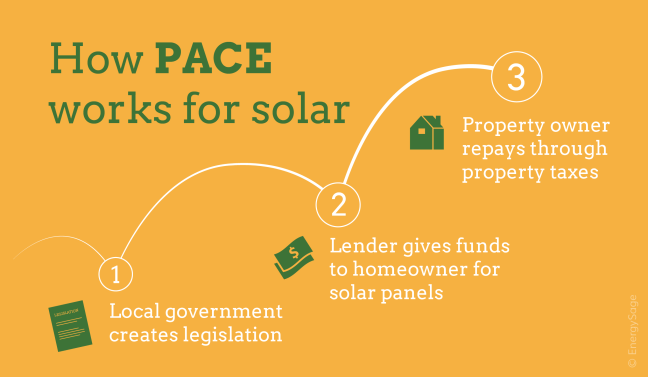
Property Assessed Clean Energy (PACE) is a financing mechanism that enables low-cost, long-term funding for energy efficiency, renewable energy and water conservation projects. PACE financing is repaid as an assessment on the property’s regular tax bill, and is processed the same way as other local public benefit assessments (sidewalks, sewers) have been for decades. Depending on local legislation, PACE can be used for commercial, nonprofit and residential properties.

pace for growers


HOW DOES IT WORK?

PACE is a national initiative, but programs are established locally and tailored to meet regional market needs. State legislation is passed that authorizes municipalities to establish PACE programs, and local governments have developed a variety of program models that have been successfully implemented. Regardless of model, there are several keystones that hold true for every PACE program.

  • PACE is voluntary for all parties involved.
  • PACE can cover 100% of a project’s hard and soft costs.
  • Long financing terms up to 20 years.
  • Can be combined with utility, local and federal incentive programs.
  • Energy projects are permanently taxed to a property.
  • The PACE assessment is led with the local municipality as a lien on the property.


ME_PACE_1


WHY IS IT SO POPULAR?

Property owners love PACE because they can fund projects with no out-of-pocket costs. Since PACE financing terms extend to 20 years, it’s possible to undertake deep, comprehensive retrofits that have meaningful energy savings and a significant impact on the bottom line. The annual energy savings for a PACE project usually exceeds the annual assessment payment, so property owners are cash flow positive immediately. That means there are increased dollars that can be spent on other capital projects, budgetary expenses, or business expansion.

Local governments love PACE because it’s an Economic Development initiative that lowers the cost of doing business in their community. It encourages new business owners to invest in the area, and creates jobs using the local workforce. PACE projects also have a positive impact of air quality, creating healthier, more livable neighborhoods.

HOW CAN I GET PACE?

We have all the tools and resources you need to get you started with PACE. We’ll be able to set you up with a custom solution that helps you finance your renewable energy upgrade for your commercial property. We look forward to hearing from you!

California’s Pot Sales Are Escalating, Along With Growers’ Energy Costs

There’s no doubt that new industries generally do not have a lot of historical data behind them to understand how they impact the economy. Regardless, data collection with the purpose to analyze impact both economically and sustainably for the cannabis industry is slowly developing. One thing that we know for sure is that indoor cannabis cultivation can be input intensive activity. It requires tremendous amount of electricity, water, chemicals (fertilizers) time and effort. Growing is truly a labor of love and if you want to be doing it for the long term you better get your ducks in a row. As this article shows the input cost for electricity is anywhere from 20-50% of input cost depending on the efficiency of the operation. These costs are only going to continue to increase in time as the electrical utilities continue to raise their rates and develop new billing structures to get more money from large consumers. Growers that embrace renewable energy will have the best chance for long term survival in this ever changing industry.

This article was originally published on Mar 5, 2018 on http://www.forbes.com and authored by Ken Silverstein.

Two months into California’s law to legalize the production and distribution of marijuana, sales are going through the roof. But so, too, are their energy bills — or at least those of growers from other states who are paying thousands a month in electricity costs. 
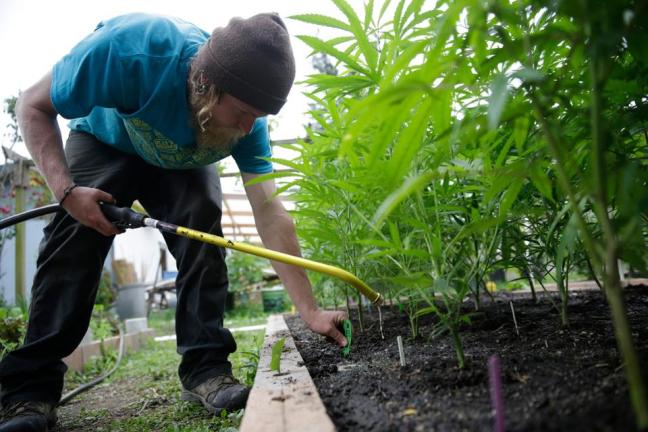
humboldtBecause cannabis has historically been outlawed, producers have grown their crops indoors, and out-of-sight. And the cost of doing so has been huge, with the Lawrence Berkeley National Laboratory estimating that growing it indoors makes up as much as 1% of the electricity use nationwide. That comes to $6 billion a year. And it amounts to 15 million tons of greenhouse gases.

The nascent industry is still struggling to get its arms wrapped around energy efficiencies and especially in states like California, Colorado and Washington State that have legalized such production and that have strict air quality rules. Before that happens, though, California has to work out more pressing kinks such as getting its growers licensed. In that state, for instance, there’s an estimated 68,000 developers and less than 1% are legally licensed to take part in the industry. Growers say that right now the cost to get licensed is too high. 

Thus, the barriers to entry are even greater, especially when you consider the high energy costs tied to cultivating the crop.

“Driving the large energy requirements of indoor production facilities are lighting levels matching those found in hospital operating rooms (500-times greater than recommended for reading) and 30 hourly air changes (6-times the rate in high-tech laboratories, and 60-times the rate in a modern home),” writes Evan Mills, in a report he authored called “The carbon footprint of indoor Cannabis production.”

Marijuana demand is expected to grow and it is now considered a $6 billion industry — set to be $50 billion by 2026, Cowen & Co. predicts.

About 30 jurisdictions across the country have legalized it for medical or recreational uses. Just about all of that is grown indoors. As such, there is a need for constant light as well as heating, ventilation and air conditioning. Until growers perfect the art of energy efficiency, energy usage will remain the biggest expense at 20% to 50% of their operating costs.

In 2015, Colorado’s marijuana industry consumed 300 gigawatt hours (GWh) of electricity. In Denver alone, that was more than 4% of the energy demand last year, up as much as 2% in previous years. In Seattle, that figure is now at 0.3% but is expected to grow to 0.5%. 

With legalization, growing cannabis crops outdoors would appear to be the optimal solution. It would certainly be lighter on the carbon footprint. While outdoor growth may be permissible in some places, it may not fit with other communities. Developers must therefore still rely on indoor cultivation, which from a quality point of view gives producers a way of controlling both the lighting and avoiding the various pests that can destroy crops.

One way to drive down the cost of indoor cultivation is to cut lighting costs, which is a big chunk of their electricity usage. To do that, they could switch to LED lighting, says Xcel Energy, in a story in the Guardian. That choice, though, also has drawbacks as it takes longer to grow the crop using LEDs. Another way is to use solar-powered roofs, although this would require an upfront capital expenditure. 

“Based on information collected from cannabis growers in Washington and Colorado, where recreational marijuana production is legal, the Council’s forecast of electricity use in the indoor production of cannabis ranges from 185-300 average megawatts region-wide over the 20-year planning horizon,” John Harrison said, in a blog for the Northwest Council. “That amount of power is roughly equal to the annual electricity use of 126,000-204,000 Northwest homes.”

For their part, utilities now have a burgeoning new industry that is demanding electricity and increasing their revenues, all at a time when new energy-saving technologies have cut into their profits. 

At the moment, both the utility and cannabis industries are learning and gathering data to make better future decisions. It’s a complex market for cannabis entrepreneurs — one that requires enough operating capital to afford not just the licensing procedures but the electricity costs as well. The learning curve, however, is becoming less onerous as an increasing number of jurisdictions are making marijuana use less risky.

This article was originally published on Mar 5, 2018 on http://www.forbes.com and authored by Ken Silverstein. To see more of his articles go to his bio.

https://www.forbes.com/sites/kensilverstein/#35e8bb9572bb